
In this article
- When the shortest route loses the race
- What is the brachistochrone curve?
- Why does the brachistochrone curve work?
- The math behind the fastest descent
- The 17th-century challenge that changed math
- What the brachistochrone curve teaches us about intuition
- Turn surprising STEM problems into meaningful practice with Nubric
- When the longer path becomes the smarter one
When the shortest route loses the race
The shortest path between two points is a straight line. So the fastest path should be a straight line too, right? Surprisingly, physics says otherwise.
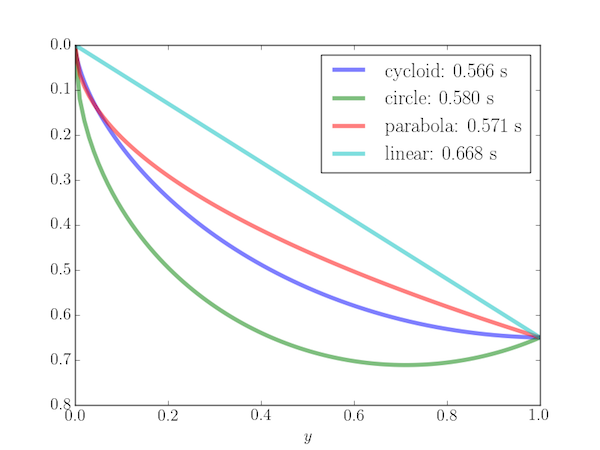
Release two objects from the same point, send one along a straight ramp and the other down a carefully designed curved path, and the object traveling farther can reach the finish first. This counterintuitive phenomenon is at the heart of the brachistochrone curve, a famous problem where math and physics challenge what seems like common sense.
So how can taking the longer route actually save time?
What is the brachistochrone curve?
The brachistochrone curve is the path along which an object moving under gravity travels between two points in the shortest possible time, assuming an idealized system without friction. The word brachistochrone comes from the Greek words brachistos, meaning “shortest”, and chronos, meaning “time”. That distinction is essential: the problem is not about finding the shortest distance, but the shortest travel time.
Imagine two points at different heights. The most direct route between them is a straight line, but an object starting from rest does not move at a constant speed. Gravity accelerates it as it descends, which means the shape of the path influences how quickly it gains speed.
The fastest route turns out to be a section of a cycloid, the curve traced by a fixed point on the circumference of a circle as that circle rolls along a straight line. Instead of heading directly toward the destination, the brachistochrone drops steeply at first and then gradually becomes flatter. That unusual shape is exactly what gives it an advantage.
Why does the brachistochrone curve work?
To have the brachistochrone curve explained, we need to stop thinking only about distance. Travel time depends on both how far an object travels and how fast it moves along the way. A straight line minimizes distance, but it does not allow the object to gain speed as quickly as the brachistochrone does.
The key is gravity. In an idealized model without friction, as an object descends, gravitational potential energy is converted into kinetic energy:
Here, m represents mass, g gravitational acceleration, h the vertical distance descended, and v the resulting speed. The important idea is straightforward: the farther the object falls vertically, the more speed it gains.
Because the brachistochrone curve descends steeply at the beginning, the object accelerates quickly and spends more of its journey traveling at a higher speed. The straight route covers less distance, but the object moves more slowly during the early part of its journey. The curved path therefore makes a clever trade-off: it accepts some additional distance in exchange for gaining speed earlier.
This is what makes the result so counterintuitive. The straight line optimizes distance, while the brachistochrone optimizes time. When speed changes throughout a journey, those two goals do not necessarily lead to the same path.
The math behind the fastest descent
To have the brachistochrone curve explained from a mathematical perspective, we need to understand why one particular shape produces the fastest journey. Why not simply make the beginning as steep as possible and then head directly toward the destination?
The answer lies in finding the right balance. A path that drops too sharply can generate a lot of speed early on, but it may also add too much distance to the rest of the journey. A path that stays relatively shallow keeps the route shorter but delays acceleration. The optimal path must balance both effects across the entire journey.
That path is a cycloid, which can be represented using two parametric equations:
In these equations, a determines the scale of the curve and θ describes the position along it. Together, they produce the characteristic cycloid shape: a steep initial descent followed by a progressively flatter path toward the destination.
What makes the brachistochrone curve particularly important in the history of math is the nature of the problem itself. Mathematicians were not simply looking for the minimum value of a particular number or equation. They needed to find the entire curve that minimizes travel time.
This type of optimization became a foundational example of the calculus of variations, a branch of math concerned with finding functions and paths that minimize or maximize a particular quantity. In the brachistochrone problem, that quantity is time.
The 17th-century challenge that changed math
The brachistochrone is much more than a clever physics demonstration. Its history involves some of the greatest mathematical thinkers of the 17th century and a challenge that helped shape an entirely new area of math.
In 1696, Swiss mathematician Johann Bernoulli presented the problem to Europe’s leading mathematicians. Given two points at different heights, he asked them to determine the path that would allow an object moving under gravity to travel from one to the other in the shortest possible time. The challenge attracted figures including Isaac Newton, Gottfried Wilhelm Leibniz, Jacob Bernoulli, Guillaume de l’Hôpital, and Ehrenfried Walther von Tschirnhaus.
Newton’s response became part of mathematical legend. According to the traditional account, he received the problem after returning home from his work at the Royal Mint and solved it that evening, submitting his answer anonymously. Bernoulli nevertheless recognized Newton’s style, reportedly remarking that one could recognize a lion by its claw.
Beyond the famous names involved, the challenge mattered because it represented a different kind of mathematical problem. Rather than asking for a number, mathematicians had to determine an optimal path. The ideas developed around problems like this eventually contributed to the calculus of variations and influenced the way optimization problems are approached in math and physics.
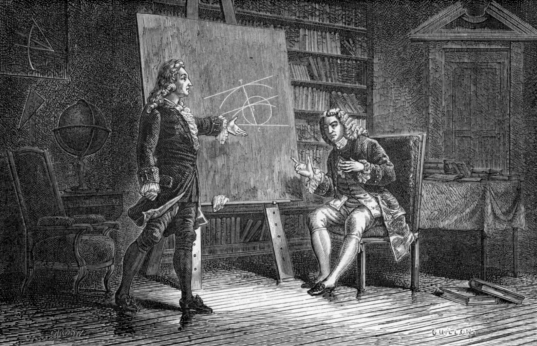
Description: Johann and Jacob Bernoulli discussing mathematical problems
What the brachistochrone curve teaches us about intuition
Once we have the brachistochrone curve explained, the result becomes much less mysterious, even if it initially feels wrong. We know that a straight line is the shortest distance between two points, so extending that principle to travel time seems reasonable. But the brachistochrone exposes the flaw in that assumption.
Shortest distance and shortest time are two different optimization problems. If speed remained constant along both paths, the shorter route would indeed be faster. But gravity continuously changes the object’s speed, so the route itself determines how quickly that speed is gained. The fastest path must therefore account for both distance and velocity.
This leads to several useful lessons:
- Optimizing one variable does not necessarily optimize another.
- A longer path can be faster when it creates a sufficient speed advantage.
- Mathematical models can produce solutions that intuition alone may overlook.
That is also why the brachistochrone is such a powerful STEM teaching example. Students can begin with a prediction, observe a result that contradicts it, and then use math and physics to understand what happened. Rather than simply applying a formula, they have a reason to investigate the concepts behind it.
Turn surprising STEM problems into meaningful practice with Nubric
Problems like the brachistochrone curve are powerful teaching opportunities because they encourage students to question their intuition and use math to explain unexpected results.
Nubric is WIRIS’ assessment and practice platform for math and STEM education, helping educators turn concepts like this into activities where students can practice, explore, and demonstrate their understanding. Its math engine can recognize mathematically equivalent expressions, making it especially useful for assessing answers that go beyond simple multiple-choice questions.
With Nubric, a surprising STEM problem can become an opportunity to move from curiosity to meaningful practice.
When the longer path becomes the smarter one
With the brachistochrone curve explained, we can see why getting somewhere faster does not always mean taking the shortest route. By descending steeply at the beginning, the cycloid allows an object to gain speed earlier and carry that advantage through the rest of its journey. The additional distance is compensated for by spending more of the journey moving faster.
More than three centuries after Johann Bernoulli posed his challenge, the brachistochrone remains a powerful example of what happens when physics, geometry, and optimization come together. It reminds us that some of the most valuable STEM problems are the ones that make the obvious answer look convincing before proving it wrong.
With tools such as Nubric, educators can turn that moment of surprise into meaningful practice, helping students move from intuition to investigation and, ultimately, to understanding.
Share


-
Try Nubric now!
High-quality maths exercises. With autocorrect.