
In this article
- Can online platforms combine AI and math education?
- How has AI for math problems transformed the daily teaching workflow?
- Why does an AI platform for math education need more than content generation?
- What online platform combines AI with specialized math education tools?
- From one question to meaningful practice
- Math learning goes way beyond content generation
- Watch the webinar and see the workflow in action
Can online platforms combine AI and math education?
Absolutely yes. Online platforms are beginning to combine AI with tools specifically designed for math education, helping teachers create activities faster while supporting the specific requirements of teaching and assessing mathematics.
Ask a general AI tool to create an algebra exercise and, within seconds, you can have a convincing-looking question on your screen. That sounds like a major time-saver for teachers. But creating the question is only the beginning.
Using AI in math education also means thinking about how students will enter their answers, whether equivalent expressions will be recognized, how responses will be graded, and what feedback students will receive.
This was the central idea behind our webinar, Transform your math class by creating quizzes with AI: AI can accelerate content creation, but an effective online math education platform also needs technology built to understand the language of math.
How has AI for math problems transformed the daily teaching workflow?
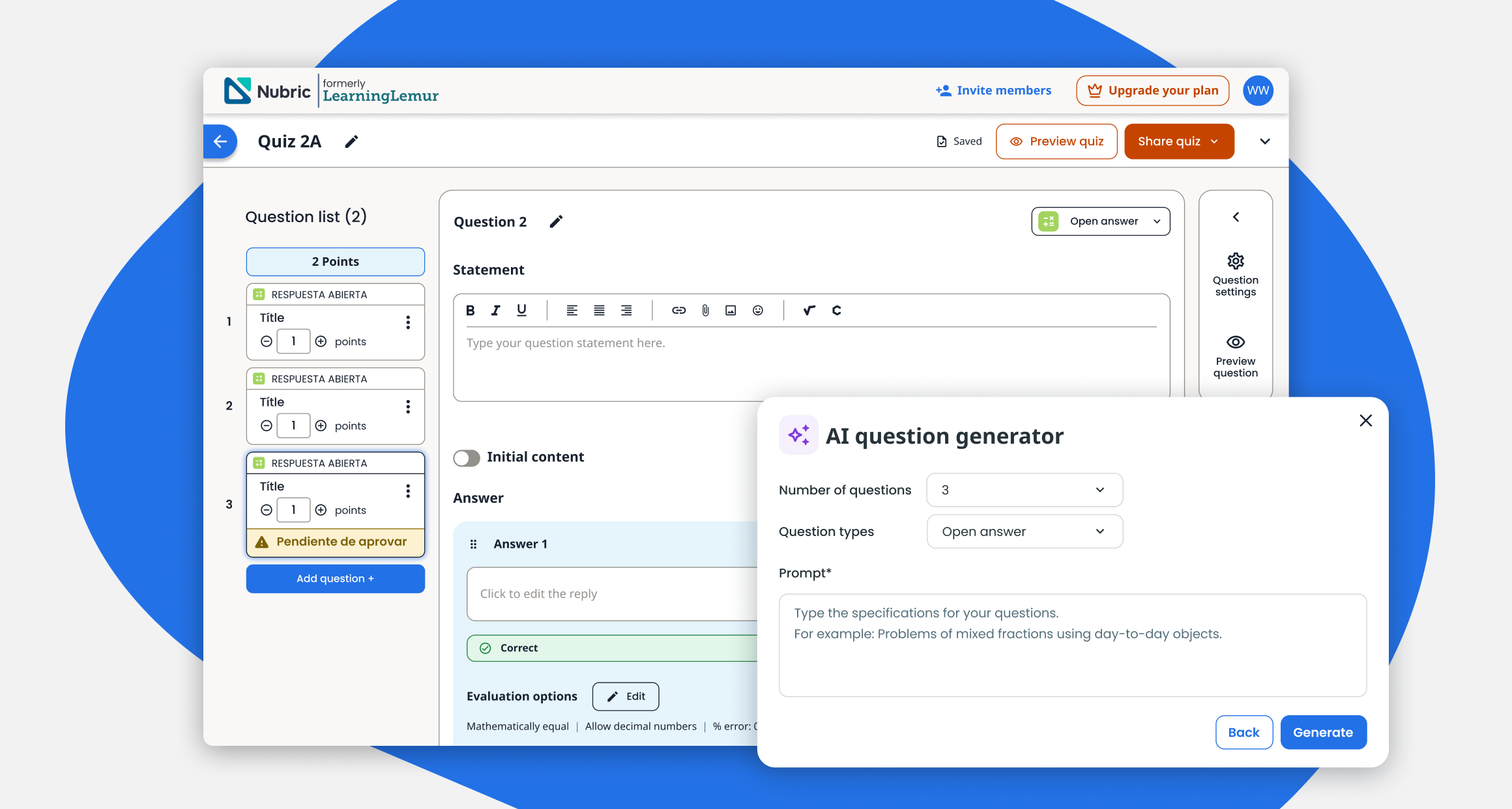
Modern AI tools can take a teacher’s pedagogical intent and quickly turn it into a draft activity. During the webinar, we demonstrated this with a simple prompt:
“Create derivative exercises for high school students. The function should be a simple polynomial. The student must apply the power rule.”
Instead of starting from a blank page, the teacher gets an editable starting point. This distinction matters. AI can accelerate the creation process, but the teacher remains responsible for reviewing the question, modifying it as needed, and determining whether it is appropriate for the students and learning objectives.
The goal is not to remove teachers from content creation. It is to reduce some of the repetitive work around authoring so they can spend more time making pedagogical decisions.

Why does an AI platform for math education need more than content generation?
Generating a question that looks correct is one challenge. Understanding a student’s mathematical answer is another.
Consider the example used during the webinar:
f(x) = x2 + 3x
The expected derivative is:
f ′(x) = 2x + 3
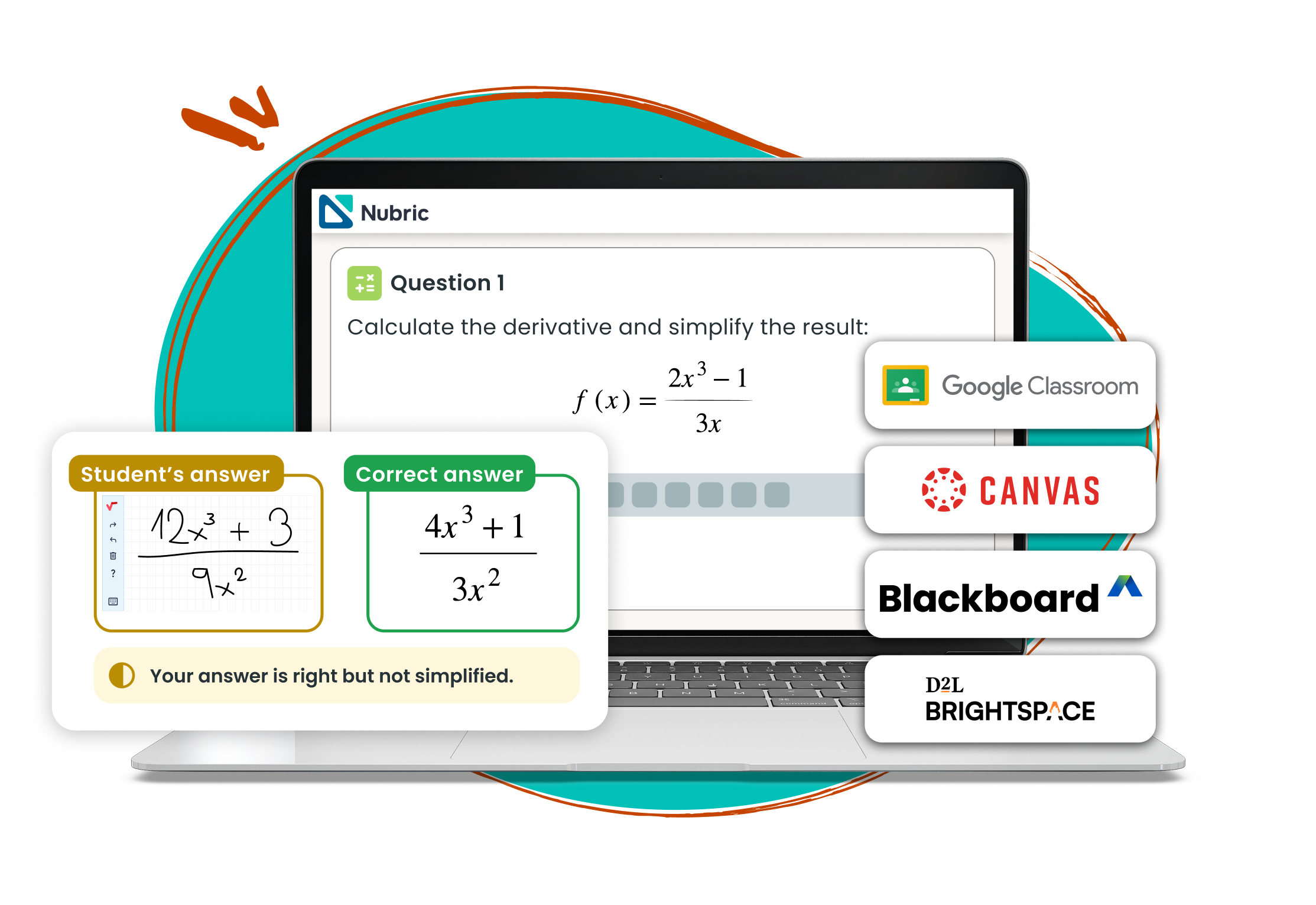
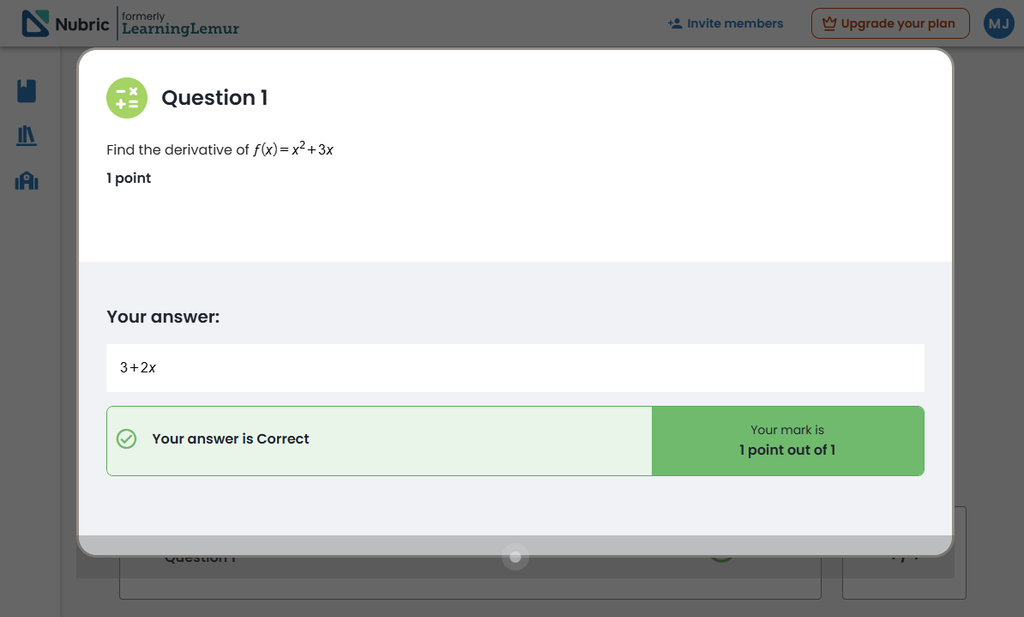
Now imagine that one student enters 2x + 3, while another enters 3 + 2x. The two responses do not contain the same sequence of characters, but mathematically they are equivalent, and both should be accepted as correct.
This is where basic text matching falls short. Effective digital math tools need to interpret mathematical syntax and equivalence. A response should not be considered incorrect simply because a student expressed the correct result in a different valid form.
That distinction is essential when thinking about AI for math problems. Generating an exercise is useful, but teachers also need a reliable way to evaluate what happens after the exercise reaches the student.
What online platform combines AI with specialized math education tools?
Nubric is Wiris’ assessment and practice platform for math and STEM education. It combines tools for creating activities with natural mathematical input, specialized evaluation and feedback, supporting the workflow from preparing a question to assessing a student’s response.
Rather than treating AI generation as the final product, Nubric uses it as part of a broader process in which the teacher remains in control.
From an AI prompt to an editable math activity
Teachers can describe the specific topic or concept they want to teach, using AI to rapidly generate a fully editable starting point instead of building exercises from scratch. Educator oversight remains central to the process, as teachers review every question before it reaches students, positioning AI as a time-saving authoring assistant that preserves teacher authority.
Let students write math naturally
Entering math digitally can create unnecessary friction for students if they are forced to learn complex syntax alongside mathematical concepts. Nubric removes this barrier by enabling students to respond using an intuitive digital math keyboard or direct handwriting recognition on touchscreens, ensuring the input method supports their ability to demonstrate understanding.
From one question to meaningful practice
A useful digital activity does not have to stop after a student submits an answer. During the webinar, we also demonstrated how feedback and randomization can extend a single question into a richer practice experience.
Teachers can add feedback to an activity so students receive an immediate response based on their answer. This can help students identify mistakes and continue working without waiting for every response to be manually reviewed. The objective is not simply faster grading, but a feedback loop that helps students understand their progress.
Random variables can also be introduced into questions so that different values are generated while the underlying mathematical concept remains the same. Instead of repeatedly solving an identical exercise, students can practice the same skill through different variations.
Together, these features help move AI for math problems beyond content generation. The question becomes part of a wider cycle of creation, practice, evaluation, and feedback.
Math learning goes way beyond content generation
Educational content creation is currently being changed by AI. The more important question for math educators is what happens after that content is generated.
AI can provide a useful starting point, but effective math practice also requires tools that can handle mathematical input, evaluate responses, and deliver useful feedback.
Nubric brings these elements together so teachers can turn AI-generated ideas into activities designed for actual classroom use.
Watch the webinar and see the workflow in action
Want to see how this works from a teacher’s and student’s perspective? In Transform your math class by creating quizzes with AI, we demonstrate the workflow from generating an exercise to editing it, entering a student response, grading equivalent expressions, adding feedback and creating randomized variations.
Share


Discover why thousands trust MathType
Enjoy 30 days of free access to MathType for Office Tools.