
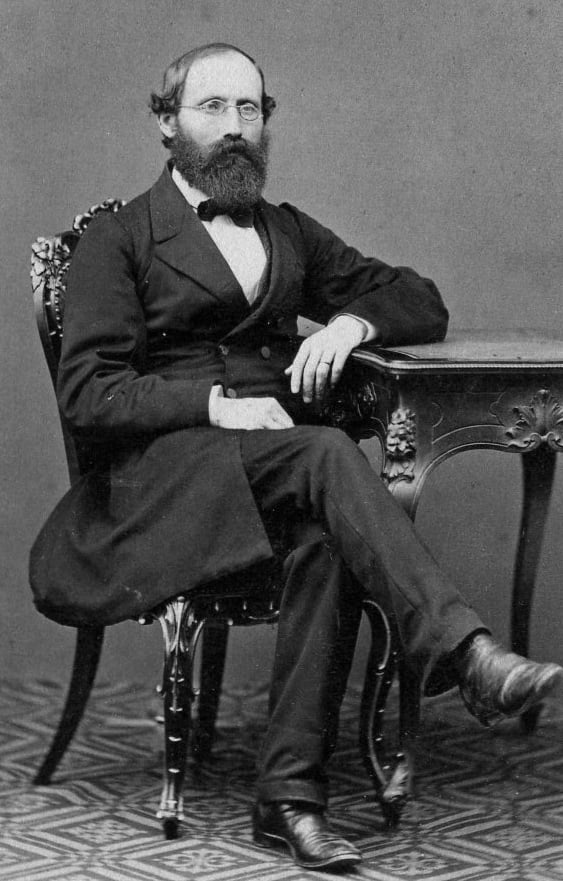
Few unsolved math problems have achieved the legendary status of the Riemann hypothesis. Proposed by Bernhard Riemann in 1859, it is one of the seven Millennium Prize Problems and carries a $1 million reward for a correct proof.
What makes the problem so fascinating is that its statement is surprisingly simple:
The real part of every nontrivial zero of the Riemann zeta function is 1/2.
That is the entire hypothesis.
Yet this apparently innocent statement has challenged generations of mathematicians and remains one of the greatest open questions in all of math. More than 160 years after Riemann proposed it, no proof or counterexample has been found.
At this point, a natural question arises: what exactly is the Riemann zeta function, what are its zeros, and why should anyone care where they are located?
The answer lies in a remarkable connection between infinite series, complex analysis, and prime numbers. Hidden within the zeros of the zeta function is information about the distribution of prime numbers, making the Riemann hypothesis one of the most influential problems in modern number theory.
To understand why, we first need to explore the remarkable function that inspired the hypothesis.
From infinite series to the Riemann zeta function
The harmonic series and the Basel problem
The story begins with one of the simplest infinite sums imaginable:
Eq. 1: Edited with MathType
This expression is known as the harmonic series. Although each term becomes progressively smaller, the series never settles around a finite value. Instead, it grows without bounds. In mathematical language, the series diverges.
Now compare it with a slightly different series:
Eq. 2: Edited with MathType
This time the result is completely different. The series converges to a finite value, and Euler famously proved that its sum is:
Eq. 3: Edited with MathType
This achievement became known as the Basel problem and marked one of the most important breakthroughs of eighteenth-century math.
More generally, mathematicians study the family of series
Eq. 4: Edited with MathType
As the exponent n increases, the series converges more rapidly and its value decreases. This naturally raises a question: what happens if the exponent is not an integer?
Extending the exponent to complex numbers
Instead of using a positive integer, suppose we replace n with a complex number s. We obtain
Eq. 5: Edited with MathType
This series converges whenever the real part of s is greater than 1.
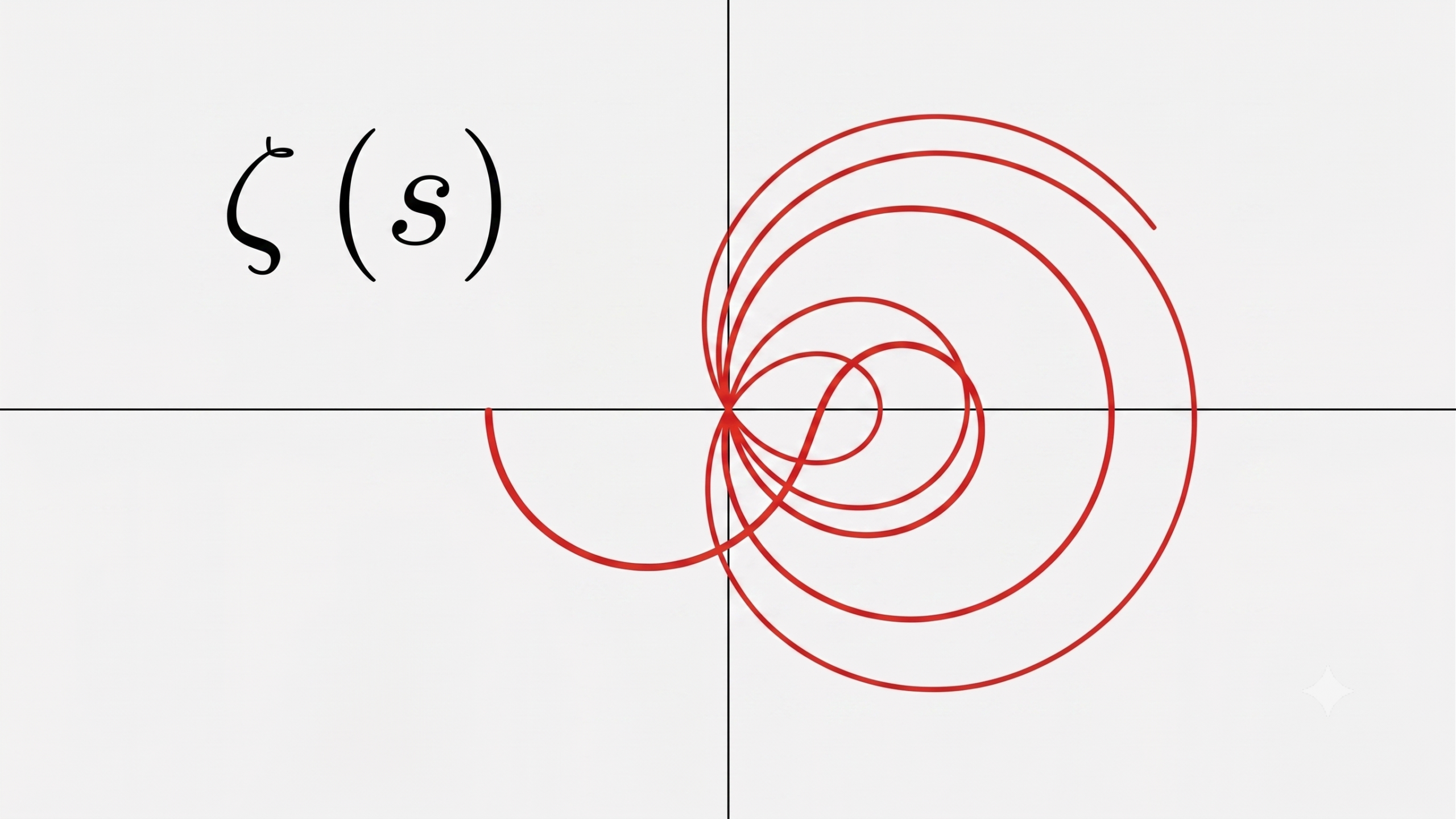
At first glance, this may appear to be a technical generalization. In reality, it leads directly to one of the most important functions in modern number theory. The function defined by this series is the starting point of the Riemann zeta function, usually written as
One of the remarkable features of the zeta function is that it transforms a simple infinite sum into a powerful tool capable of describing deep properties of prime numbers.
Why analytic continuation changes everything
The series defining ζ(s) only converges when the real part of s is greater than 1. Riemann’s breakthrough was to extend the function beyond this region using a technique called analytic continuation.
Through analytic continuation, the zeta function can be defined throughout almost the entire complex plane while preserving all the information contained in the original series. This extension is important because many popular mathematical curiosities arise from confusing the original series with its analytic continuation.
For example, many people have seen the statement
Eq. 6: Edited with MathType
Taken literally, this is false. The series clearly diverges. However, the value -1/12 appears when evaluating the analytic continuation of the Riemann zeta function at s = -1.
To see why, consider the original definition of the zeta function:
Eq. 7: Edited with MathType
If we formally substitute s = -1, the denominators become numerators:
Eq. 8: Edited with MathType
The problem is that the original series only converges when the real part of s is greater than 1, so this substitution lies outside its domain of validity. The value -1/12 comes from the analytic continuation of the zeta function, not from the original infinite sum itself.
In other words, the original series and the zeta function agree where the series converges, but the analytic continuation extends the function far beyond that domain.
This ability to work with functions outside their original region of definition is one of the most powerful ideas in complex analysis and forms the foundation of the Riemann hypothesis itself.
The ideas behind analytic continuation are often introduced in advanced university courses, where students must work with increasingly complex mathematical notation. Being able to write and visualize functions clearly becomes particularly important when studying topics such as the Riemann zeta function. Tools like MathType help educators and students communicate these expressions accurately across digital learning environments.
Understanding the Riemann hypothesis
Trivial zeros and non-trivial zeros
Once the zeta function has been extended to the complex plane, mathematicians can ask where it becomes equal to zero.
In other words, for which values of s do we have
Eq. 9: Edited with MathType
These values are called the zeros of the zeta function.
Some of them are easy to identify. Every negative even integer makes the zeta function vanish:
-2, -4, -6, -8, -10…
These are known as the trivial zeros. They arise naturally from the functional equation of the zeta function:
Eq. 10: Edited with MathType
The equation contains the factor
Eq. 11: Edited with MathType
Whenever s is a negative even integer, this sine term becomes zero, forcing the entire expression to vanish. As a result, the values and so on are automatically zeros of the zeta function. Because their origin is well understood, they are referred to as the trivial zeros.
The real mystery begins with all the remaining zeros.
These solutions are called non-trivial zeros, and they contain the information that ultimately led Riemann to formulate his famous conjecture.
The critical strip and the critical line
Riemann proved that every non-trivial zero lies within a specific region of the complex plane known as the critical strip:
0 < Re(s) < 1
This result immediately narrows the search to a relatively small region of the complex plane. As we will see later, the location of these zeros plays a crucial role in understanding how prime numbers are distributed, which is ultimately why the Riemann hypothesis is considered so important.
Inside the critical strip lies an especially important line:
known as the critical line.
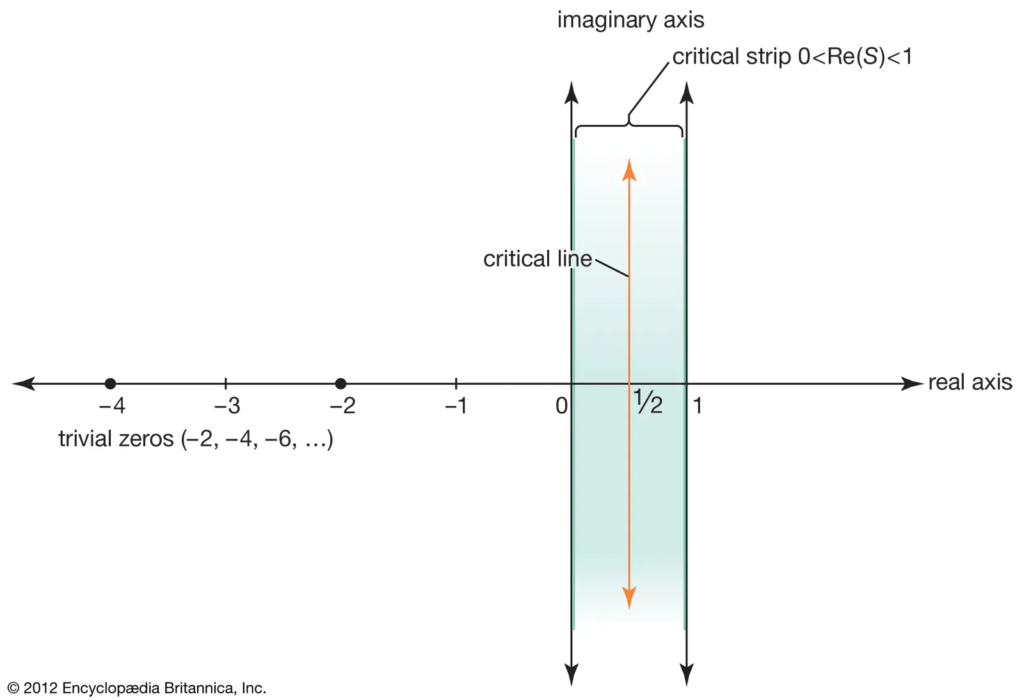
When Riemann calculated the first non-trivial zeros of the zeta function, he noticed that they appeared to lie precisely on this line. Further computations over the following decades revealed the same pattern again and again.
This observation eventually led to one of the most famous statements in all of math.
As we said previously, the Riemann hypothesis states:
Every non-trivial zero of the Riemann zeta function has a real part equal to 1/2.
That is the entire conjecture.
Its simplicity is part of what makes it so fascinating. The statement itself can be explained in a few lines, yet no proof has been found despite more than a century and a half of effort.
Why mathematicians believe the hypothesis is true
The evidence supporting the hypothesis is extraordinary. Among all unsolved math problems, few have accumulated such a vast amount of computational and theoretical evidence while remaining beyond the reach of a complete proof.
Billions of non-trivial zeros have been computed, and every one of them lies on the critical line. Furthermore, mathematicians have proved that infinitely many zeros must lie there.
Current research has also established that a significant proportion of all zeros belong to the critical line. No counterexample has ever been discovered.
Yet numerical evidence can never replace a mathematical proof.
Even if trillions of zeros satisfy the conjecture, a single zero outside the critical line would be enough to make the hypothesis false. This is why the problem remains open despite overwhelming computational support.
Why the Riemann hypothesis is really about prime numbers
Euler’s remarkable product formula
At first sight, the Riemann zeta function appears to be a function of an infinite series. In reality, it is also deeply connected to prime numbers.
Euler discovered the remarkable identity
Eq. 12: Edited with MathType
where the product extends over all prime numbers.
This formula is extraordinary because it connects two seemingly unrelated worlds. On one side is an infinite sum involving every positive integer. On the other side is an infinite product involving only prime numbers. The identity reveals that the zeta function contains information about every prime simultaneously.
This connection is the reason number theorists care so much about the zeros of the Riemann zeta function.
The prime-counting function
One of the oldest questions in number theory concerns the distribution of prime numbers. To study this problem, mathematicians use the prime-counting function π(x), which counts the number of primes less than or equal to x.
For example:
Although prime numbers appear irregularly when viewed individually, their overall distribution follows surprisingly predictable patterns. One of the greatest discoveries in number theory, the Prime Number Theorem, states that
As x becomes very large.
An even more accurate approximation is provided by the logarithmic integral function Li(x). The difference between the two functions may seem small, but understanding this error turns out to be one of the deepest questions in number theory.
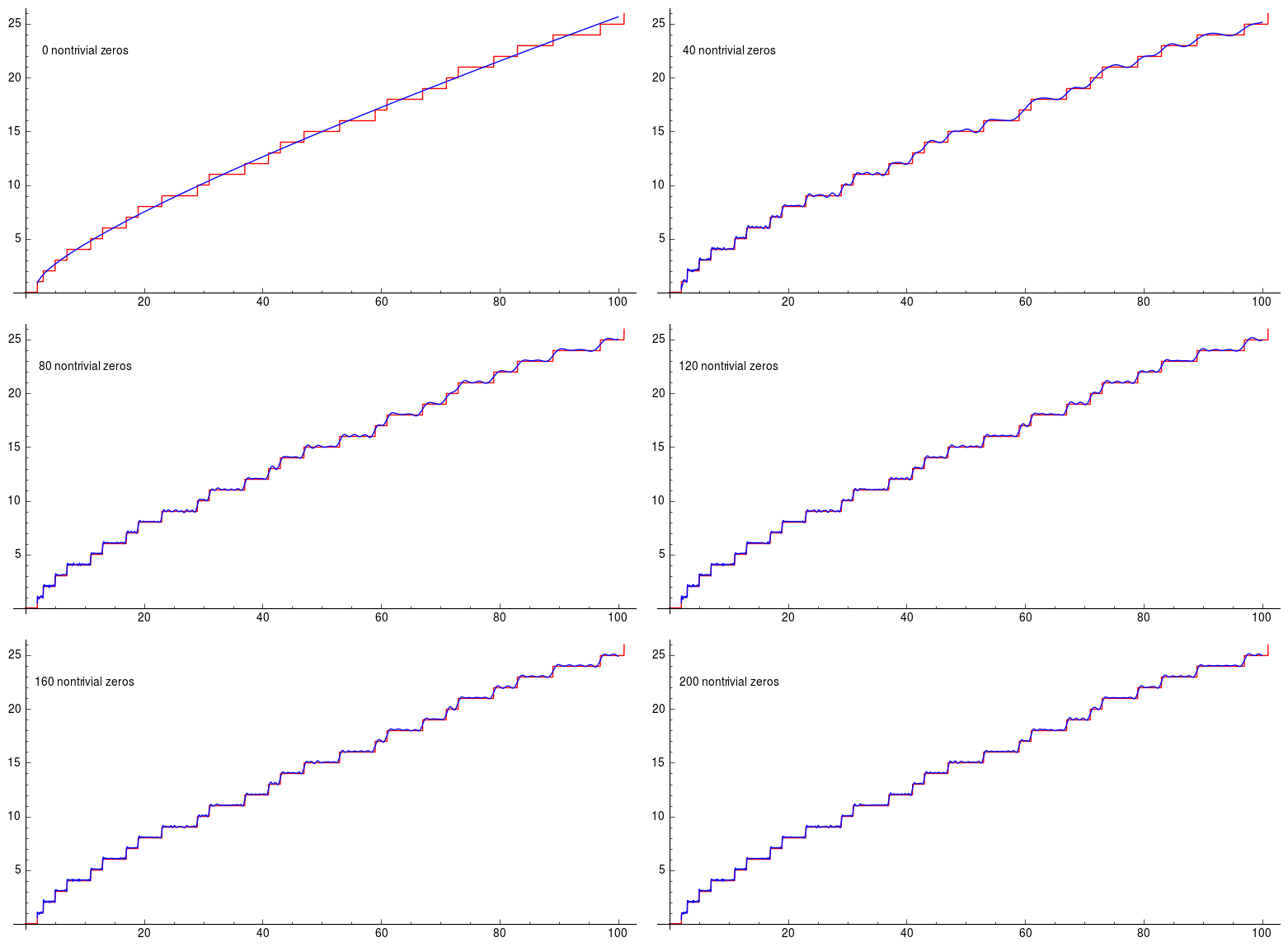
How the zeros of the zeta function control the distribution of primes
Earlier, we saw that all non-trivial zeros must lie inside the critical strip. We can now understand why their location matters so much.
The error between π(x) and its approximations is closely related to the location of the non-trivial zeros of the Riemann zeta function. If a zero were found far from the critical line, that error could become significantly larger than expected. If every non-trivial zero lies exactly on the critical line, as the hypothesis predicts, mathematicians obtain the strongest known estimates for the distribution of prime numbers.
In other words, the Riemann hypothesis is not merely a statement about complex numbers. It is a statement about how accurately we can predict the distribution of prime numbers. This connection between the zeros of the Riemann zeta and the behavior of π(x) is the main reason the hypothesis remains one of the most important unsolved math problems in modern research.
What happens if the hypothesis is true… or false?
The importance of the Riemann hypothesis extends far beyond the study of the Riemann zeta function. A proof would strengthen many results in number theory, improve estimates related to prime numbers, and provide new tools for studying arithmetic functions and Diophantine equations. Researchers have also discovered intriguing connections between zeta zeros, random matrix theory, and mathematical physics, highlighting the hypothesis’ influence across modern math.
If the hypothesis is true
A proof would confirm one of the most influential predictions in modern number theory.
Researchers would obtain stronger estimates for prime distribution, many conditional theorems would become unconditional, and our understanding of arithmetic functions would improve significantly.
More importantly, mathematicians would finally understand why the critical line plays such a fundamental role in the structure of the zeta function.
If the hypothesis is false
The discovery of a single non-trivial zero outside the critical line would be one of the most surprising events in the history of math.
Such a result would force researchers to re-examine many assumptions that have guided number theory for more than a century.
While numerous mathematical results would remain valid, many expectations about prime numbers would need to be reconsidered.
Either outcome would reshape the field.
A problem that continues to shape modern math
More than 160 years after Bernhard Riemann published his groundbreaking paper, the Riemann hypothesis remains one of the most famous unsolved math problems in modern research.
Its statement occupies a single sentence, yet its consequences extend throughout number theory, complex analysis, and mathematical physics.
The problem began as a question about the zeros of the Riemann zeta function, but it ultimately became a question about the hidden structure of prime numbers themselves. Whether the hypothesis is eventually proven true or false, its resolution will almost certainly rank among the most important achievements in the history of modern math.
Until then, it remains the ultimate challenge for researchers seeking to understand one of the deepest mysteries ever discovered in number theory.
Share


Discover why thousands trust MathType
Enjoy 30 days of free access to MathType for Office Tools.