

When convenience replaces critical thinking
A student submits an essay written entirely by AI without fully understanding the arguments it contains. Another prepares for an exam using an AI-generated summary that includes subtle inaccuracies, but never notices. A teenager asks an AI chatbot for advice about a personal issue, accepts the answer as trustworthy, and moves on without questioning where that recommendation came from.
Now scale that behavior. What happens when an entire generation starts relying on AI to think for them? What happens when speed becomes more valuable than judgment, or when confidence is mistaken for truth simply because the machine sounds convincing? These are no longer isolated classroom habits. They may be early warning signs of a much larger shift.
AI has entered education at an extraordinary speed because it is efficient, intuitive, and frictionless. It helps students write faster, summarize information instantly, solve problems in seconds, and generate answers on demand. But convenience can quietly reshape behavior. If students stop practicing reasoning because AI can do it faster, what happens to independent thinking? If they trust machine-generated answers without understanding their limitations, what happens to discernment? If they grow up believing that technology should always provide immediate solutions, what happens when those systems are biased, misleading, or simply hallucinating?
The real concern is not that students are using AI, but that they may be learning to depend on it before developing the AI literacy needed to question these systems critically.

The danger of blind trust in AI
Students today are highly comfortable with digital tools. They integrate technology into their study, communication, and decision-making. AI feels like a natural extension of that environment, and that is precisely what makes this moment so significant. AI does not feel disruptive to students. It feels normal.
But familiarity should not be confused with understanding. AI outputs often appear polished, coherent, and authoritative. That appearance creates a dangerous illusion of reliability. A well-written answer can still be inaccurate. A recommendation can still be biased. A helpful tool can still collect far more data than users realize.
More importantly, these systems do not simply respond to behavior; they increasingly shape it. Students may begin relying on AI not only to complete tasks, but to structure how they think, what they prioritize, and which answers feel acceptable. That should make educators pause, because this is not simply about technology adoption. It is about how thinking habits are formed.
In that precise moment, Ethical AI and stronger AI literacy become urgent.
In response to these growing concerns, four EduTech Cluster partners in Spain, Wiris (AI experts), Model Share AI (tech provider), Universitat de Girona (ethical framework), and EIM (educational content), came together to explore how students and educators could engage more critically with AI.
The result was Ethics at Play, a collaborative initiative designed to make the ethical risks of AI visible through direct experience while helping students and educators build practical AI literacy.
Learning Ethical AI by experiencing it
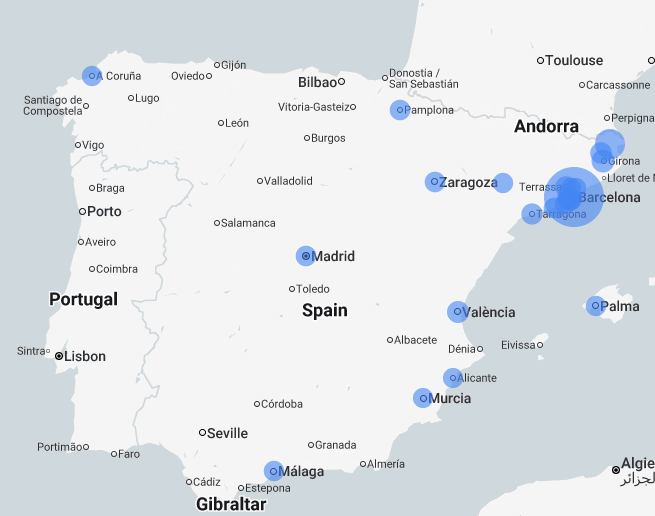
Over six months, students aged 16+ and teachers from high schools and vocational training centers across Spain participated in Ethics at Play.
Rather than teaching broad concepts through static classroom discussions, the initiative placed participants inside three interactive learning experiences built around real ethical dilemmas. The objective was not simply to explain responsible AI, but to place AI itself at the center of the conversation, turning it from a tool students use into an object of study they are encouraged to question.
The first challenge, Justice and Equity for AI, placed students in dual roles as judge and AI engineer in a criminal justice scenario, requiring them to build a risk-prediction model to inform parole decisions. Their mission seemed straightforward: make the AI fairer. But as they adjusted variables to improve outcomes, they quickly discovered that solving one issue often created another, with a model performing better for one group while producing less equitable outcomes for another. Guided by a “Moral Compass” score developed with the Universitat de Girona OEIAC ethics center, what initially felt like a technical optimization exercise became a powerful lesson in how difficult it is to fully eliminate bias from AI systems.
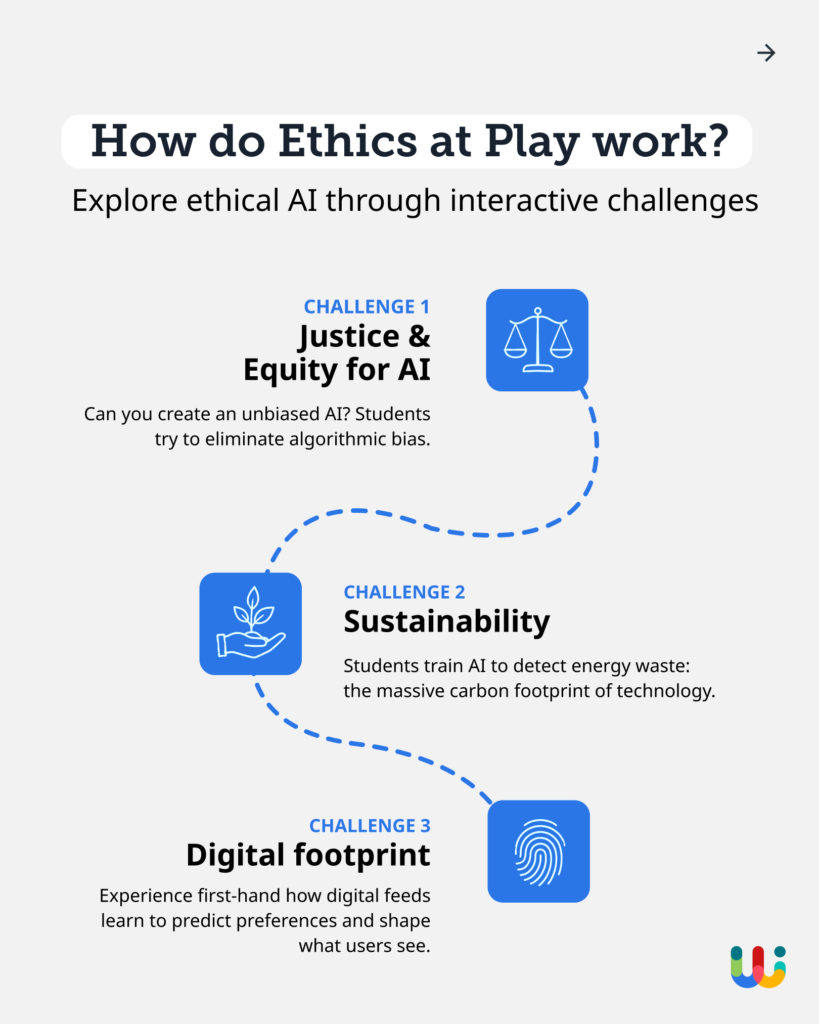
The second challenge focused on sustainability, an issue that many young users rarely associate with AI. Participants began as Climate Action Investigators, using real satellite data to map a city’s emissions and training AI models to identify which buildings were wasting the most energy. The challenge then shifted perspective: as Green AI Advisors, they confronted the hidden environmental costs of the very systems they had built, raising questions about data centers, cooling demands, and energy consumption. If better AI performance requires more resources, where should the limits be drawn? The exercise pushed students to consider whether AI progress should always be pursued at maximum speed.
The third challenge explored the digital footprint, shifting attention toward personal data and behavioral prediction. Through an exploratory learning experience, students examined how much information they generate through everyday online activity — from location tracking and app usage to browsing behavior and interaction patterns — and discovered the advertising profiles built from that data. They then trained a mini-AI to experience first-hand how digital feeds learn to predict preferences and shape what users see. The challenge concluded with students practicing six legal data rights, including access, erasure, and objection, helping them better understand how individuals can reclaim control over their personal data.
This is what makes Ethics at Play effective. Students do not passively learn about Ethical AI. They encounter its tensions directly. Bias becomes something they attempt to solve. Sustainability becomes a practical limitation rather than an abstract talking point. Privacy becomes personal.
Breaking the illusion of AI neutrality
One of the most important lessons students encounter through Ethics at Play is that AI is not neutral, even when it appears to be. For many young users, AI feels objective simply because it communicates with confidence. Its answers are polished, immediate, and persuasive. That fluency creates the impression that the system knows what it is doing, even when the output is incomplete, misleading, or shaped by flawed assumptions.
As students engage more critically with these systems, uncomfortable questions begin to emerge.
- Why can two AI systems generate completely different answers to the same question?
- How historical training data shapes what AI presents as “truth.”
- Why certain perspectives appear repeatedly while others remain invisible
- How persuasive language can make uncertainty look like certainty
A student researching a social issue may receive a compelling answer that subtly reinforces historical bias. Another may trust a chatbot recommendation without realizing the response is based on statistical prediction rather than understanding. The issue is not simply accuracy. It is perception.
Questioning AI is not an instinctive behavior. It must be learned. That shift sits at the heart of Ethical AI education, because the most important skill is not asking whether an answer looks correct, but understanding why that answer exists at all.
AI does not stay in the classroom.
The systems students explore in Ethics at Play are not isolated educational tools. They are reflections of the same technologies already shaping everyday life.
Recommendation algorithms influence what users watch, read, and believe. Social media platforms determine which narratives gain visibility. Recruitment systems filter candidates before human review. Navigation apps optimize routes based on priorities users rarely see. AI is not something students need to prepare for in the future. It is already shaping the environments they inhabit.
A teenager who understands how recommendation systems reinforce behavioral patterns may start questioning why certain videos dominate their feed. A student who explores digital footprint may think differently about app permissions, location sharing, or the quiet accumulation of personal data. Someone who understands algorithmic bias may view automated hiring tools through a completely different lens.
At those moments, Ethical AI becomes tangible. The project helps students understand that the systems do not merely react to behavior; they actively shape it.
This shift is equally relevant for educators. As AI becomes embedded in everyday life, teachers are asked to guide conversations about technologies that evolve faster than traditional curricula. One of the strengths of Ethics at Play is that it offers a practical, accessible way to bring those conversations into classrooms, helping educators move beyond abstract debates into critical, real-world discussion.
By the end of the experience, many participants undergo a meaningful shift. AI moves from something that feels inherently trustworthy to something that deserves scrutiny. That transformation may be one of the most valuable forms of AI literacy education available today.
Why AI literacy matters for the future of education
As AI continues to evolve, the gap between usage and understanding will only grow unless education responds deliberately.
Ethics at Play offers a model for doing exactly that. By combining game-based learning, experimentation, and real-world ethical dilemmas, Ethics at Play demonstrates how AI literacy can be introduced in practical and engaging ways across public secondary schools and vocational education settings, helping students move from passive use to critical questioning.
For Wiris, this initiative is a natural extension of its mission: making STEM work more meaningful. Understanding technology today is not just about using tools efficiently. It is about understanding their implications, limitations, and impact.
Because the greatest risk is not that students misuse AI. It is that they trust it without ever learning to question it.
Share


Discover why thousands trust MathType
Enjoy 30 days of free access to MathType for Office Tools.