In this article
Rethinking how students engage with math problems
Math Problems are central to STEM education, but solving them is only part of the learning process. What truly shapes understanding is how students validate their answers and how often they can practice with meaningful variations.
Rethinking how students engage with math problems means focusing on three key elements: immediate feedback, mathematically correct evaluation, and access to varied but structured practice.
LearningLemur is built around this approach. It allows students to solve problems, submit their answers, and instantly verify whether their solutions are correct. This creates a continuous cycle of practice, validation, and improvement that strengthens both accuracy and confidence.
A digital engine for creating and assessing math problems
LearningLemur brings together the key elements that reshape how students work with math problems. It combines automatic grading, mathematical equivalence checking, and controlled problem generation to support a more effective practice cycle.
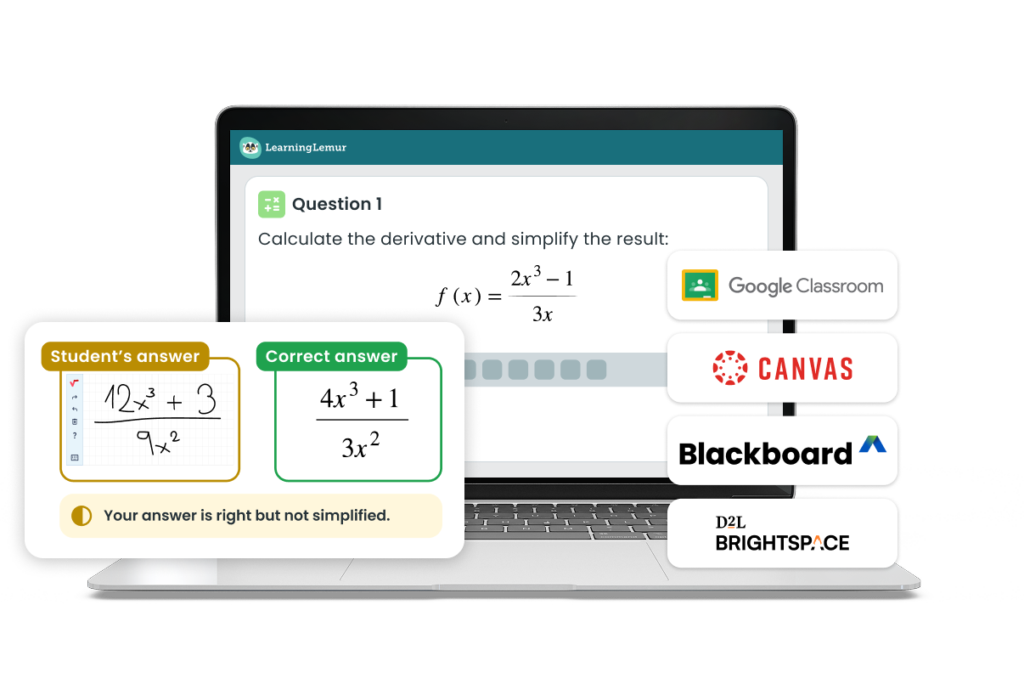
Its key capabilities include:
- Automatic grading of open math answers
- Mathematical equivalence checking, not just exact matching
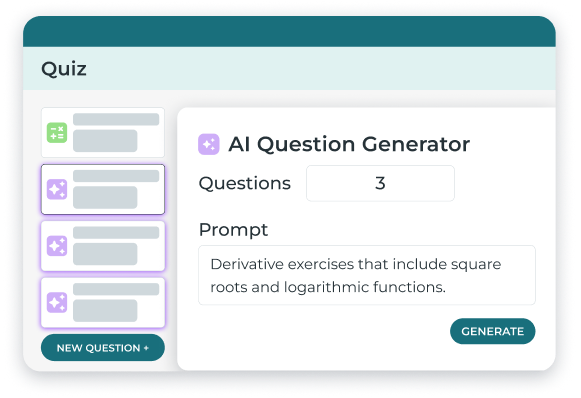
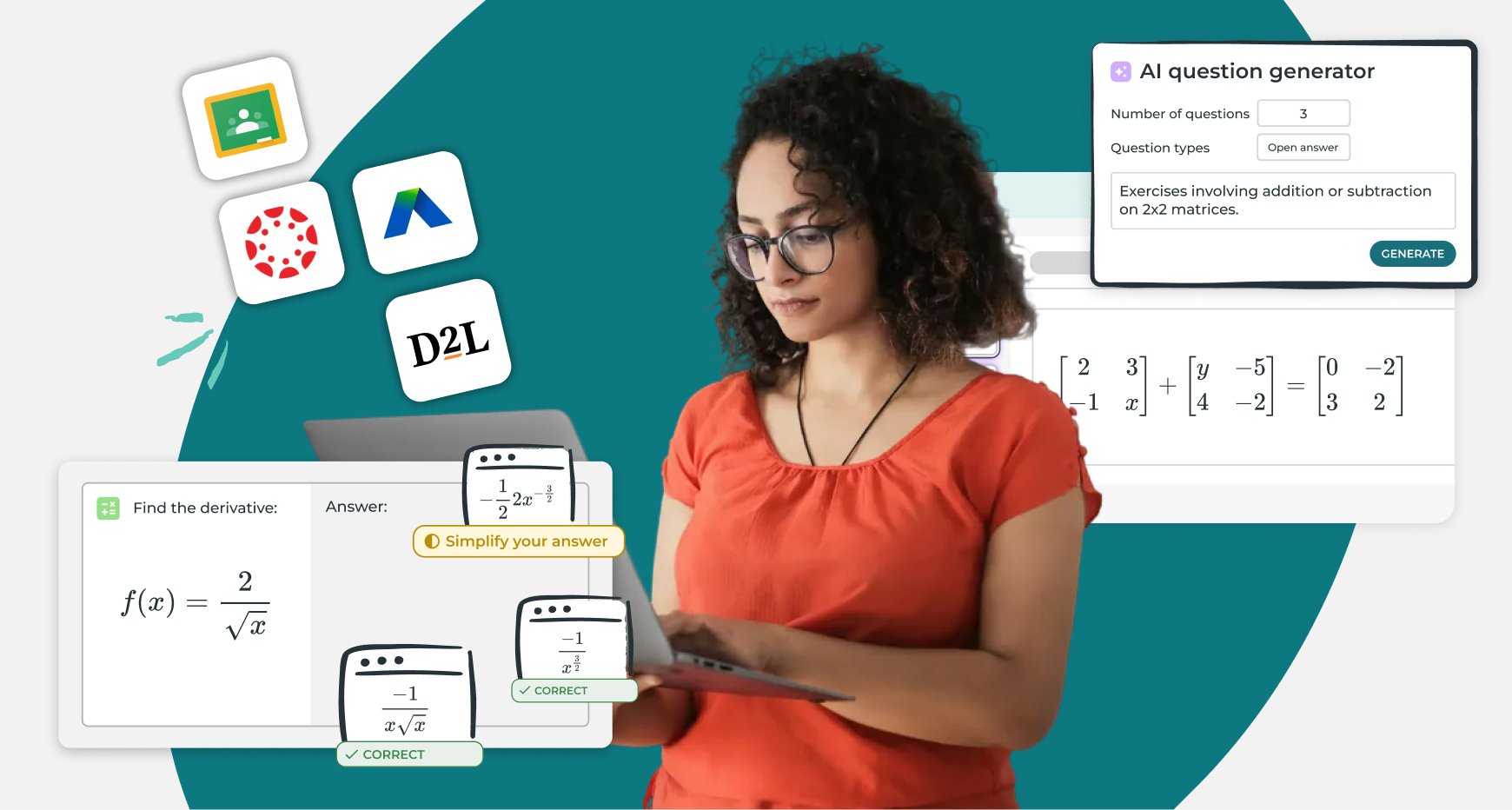
- AI-powered question generation
- Randomized problem parameters
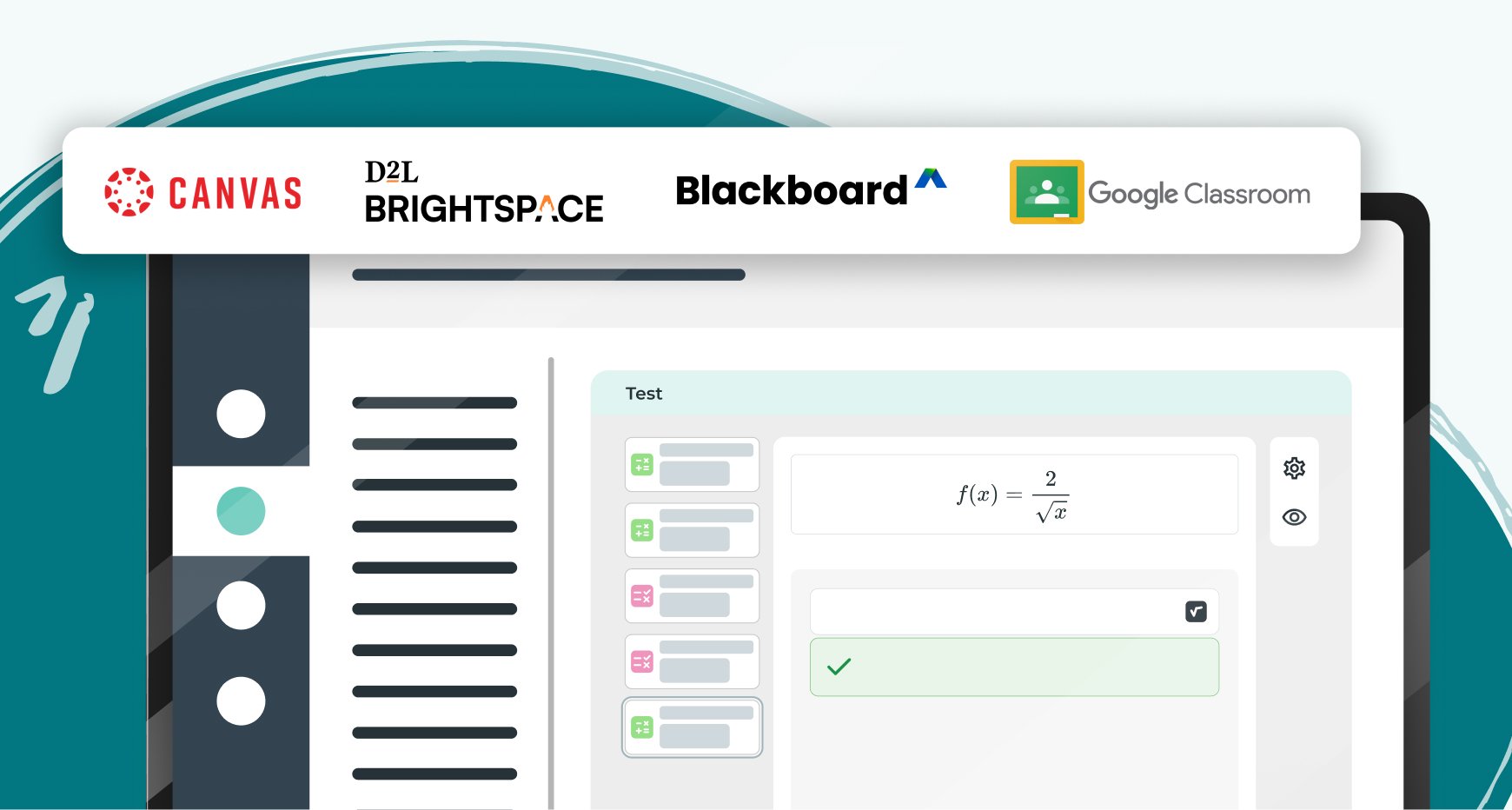
- Integration with Google Classroom, Canvas, Blackboard, and D2L Brightspace
- Handwriting recognition on touch devices
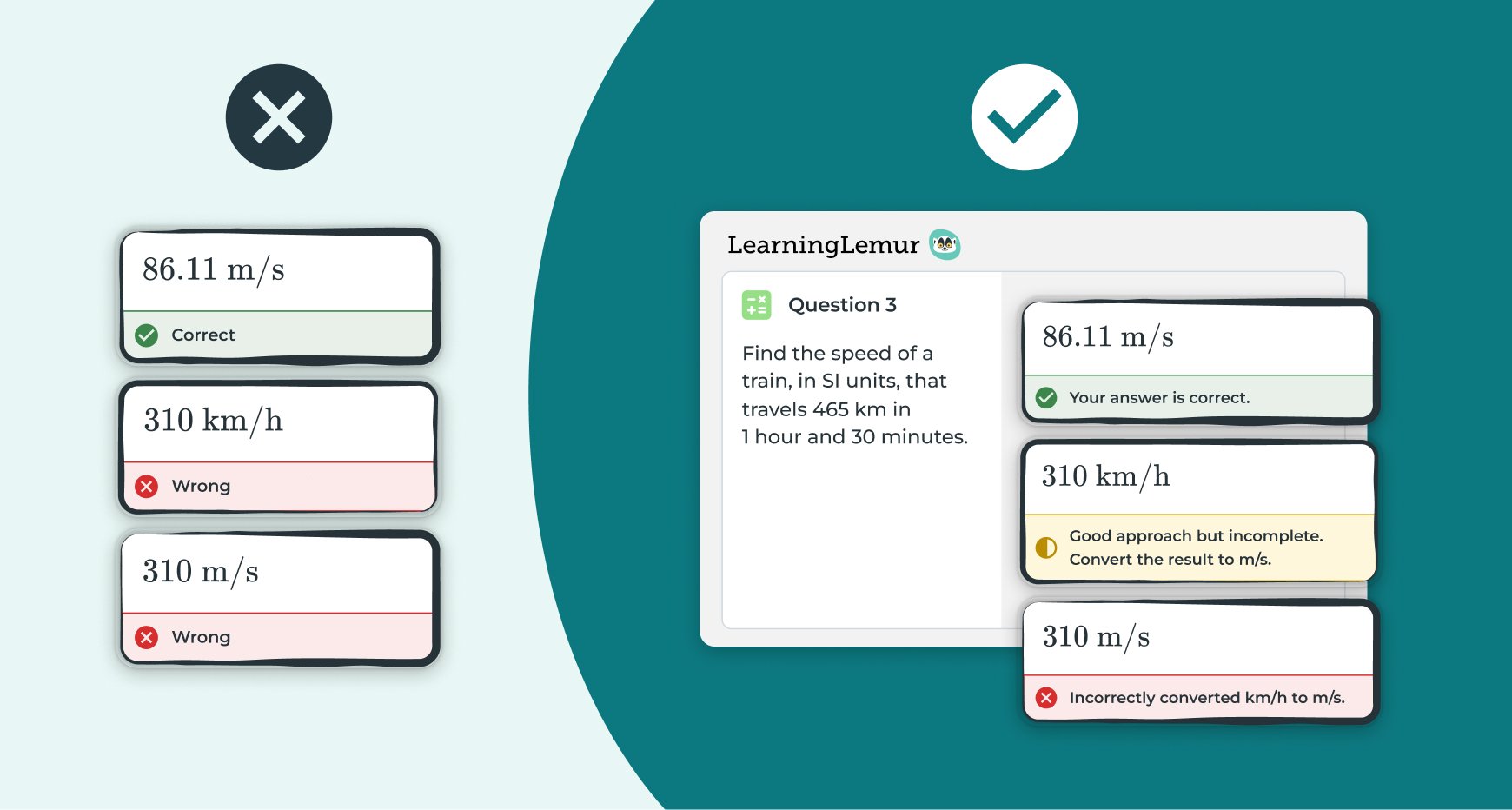
This means teachers can generate varied versions of the same exercise, while students receive immediate correctness feedback when solving math problems. The result is a fast feedback loop that supports independent reasoning.
From school-level functions to university algebra
One of the strengths of LearningLemur is that the same workflow for solving math problems can be applied across very different academic contexts.
In secondary education, students often work on foundational topics such as algebraic manipulation, functions, and introductory calculus. In higher education, the focus shifts toward more abstract concepts, including multivariable calculus, linear algebra, and other advanced STEM subjects.
LearningLemur supports this progression by providing a consistent environment where students practice math problems, submit their answers, and receive immediate correctness validation. The platform does not change the mathematical reasoning required for each task, but it simplifies the process of assigning, submitting, and evaluating solutions.
For educators, this means that the same system can support a wide spectrum of courses, from early algebra practice to more advanced university-level exercises. The result is a scalable assessment workflow that remains focused on rigorous solving math problems.
This consistency reinforces a unified approach to solving math problems, regardless of complexity.
First Problem: Finding the extrema of a quadratic function
Let us begin with a quadratic function typically studied in secondary education. All formulas are written using MathType.
Find the extrema of the function f(x) = 3x2 + 3x + 4
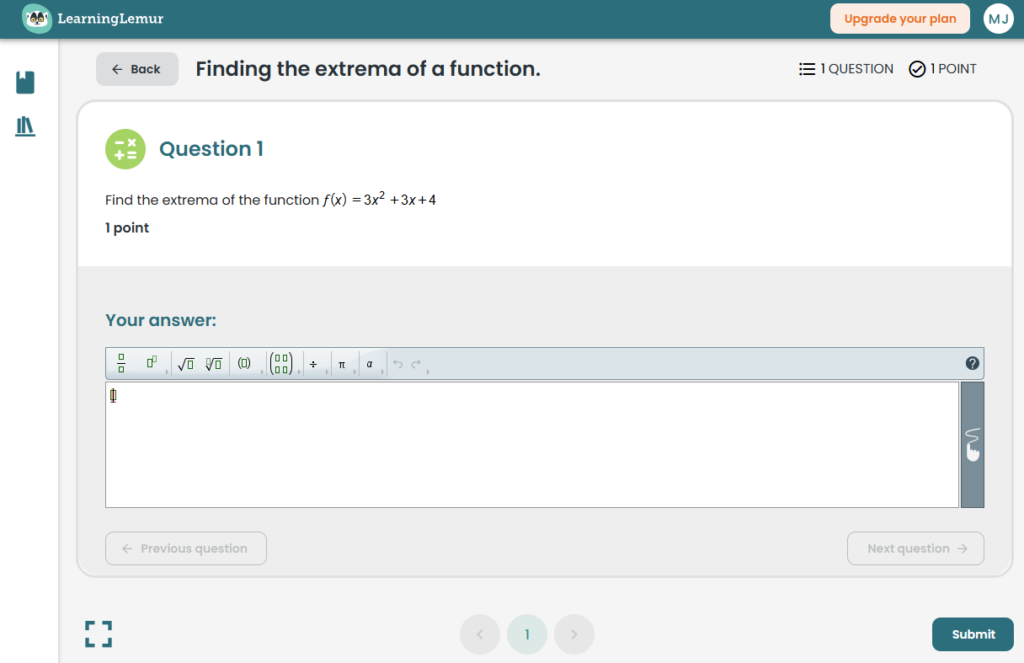
To solve this math problem, students must compute:
First derivative:

Solve for critical points:


Now compute the corresponding y-coordinate:



Therefore, the extremum occurs at the point:

Since the quadratic coefficient is positive, the function opens upward, and the extremum is a minimum.
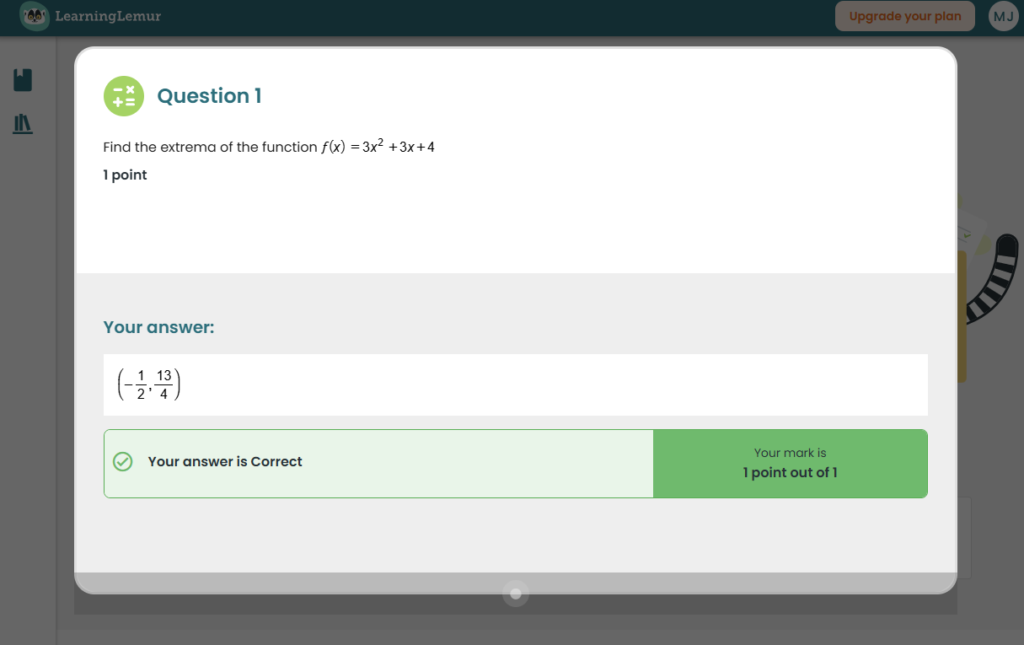
The student enters the final result directly into LearningLemur. The platform evaluates whether the extrema are correct.
Because LearningLemur checks mathematical equivalence, equivalent expressions or formats are recognized as correct. This flexibility strengthens accuracy when solving math problems, especially in algebraic contexts.
Computing eigenvalues with automatic validation
Now consider a university-level algebra example. All formulas are written using MathType.
Find the eigenvalues of the matrix:

Here’s how a student would visualize the second problem in LearningLemur:
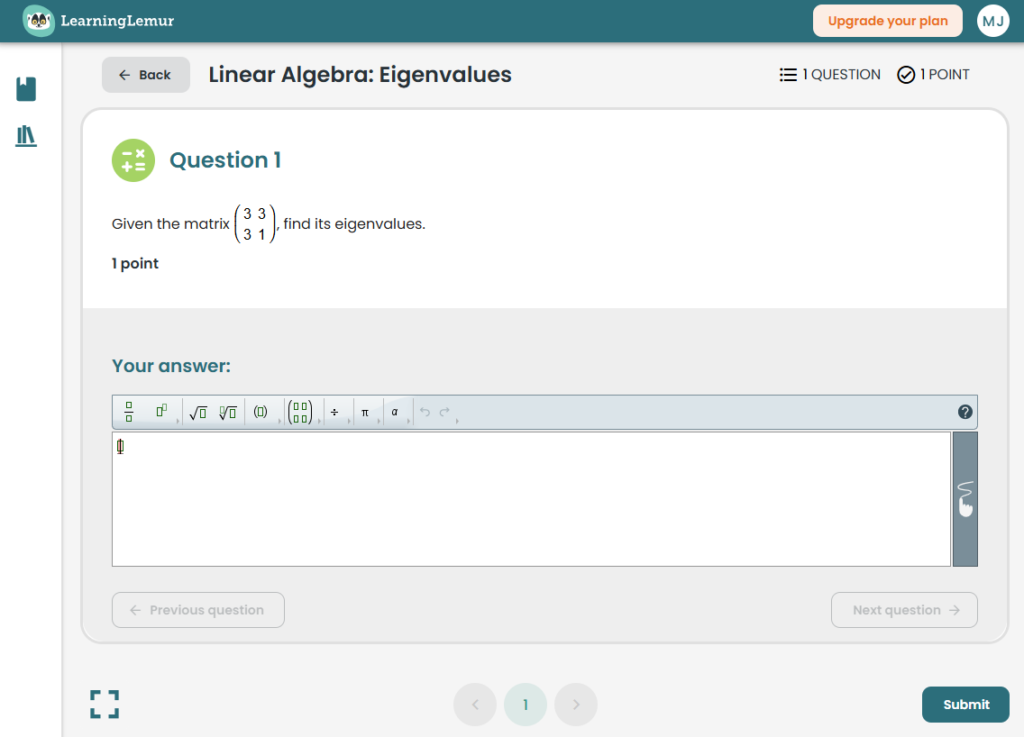
To solve this math problem, students compute the characteristic equation:

First, subtract λ from the diagonal entries:

Now compute the determinant:

Expanding the expression:

So the equation becomes:
Next, solve the quadratic equation using the quadratic formula:


This produces two eigenvalues:


The student submits these two eigenvalues as the final answer. LearningLemur then evaluates whether the solutions are mathematically correct.
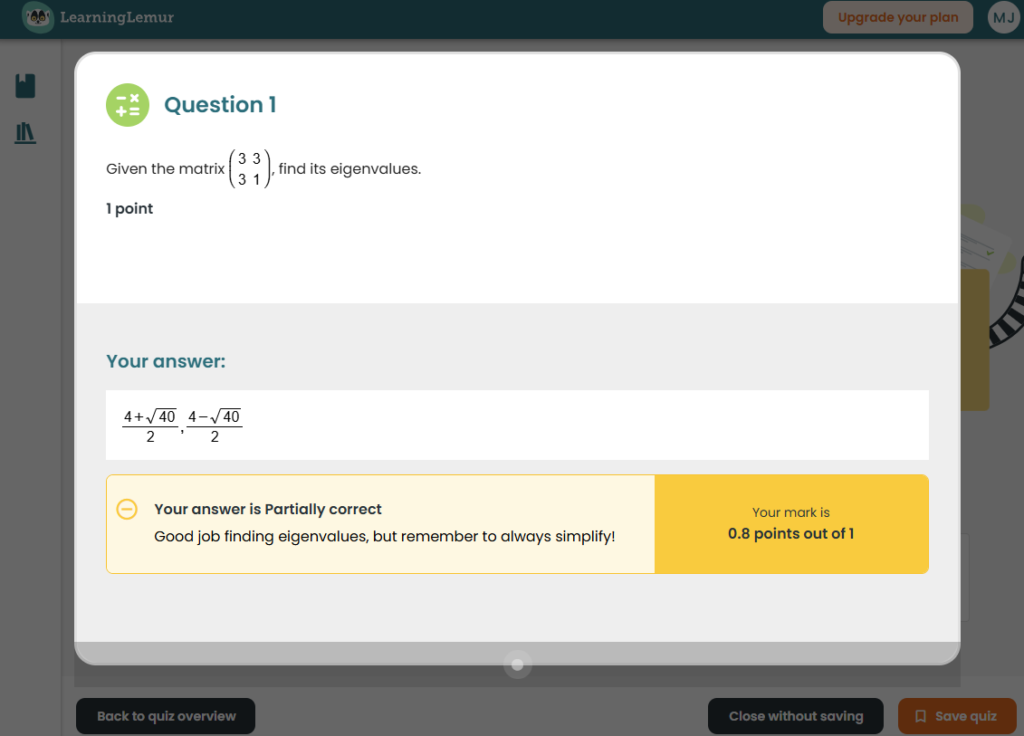
When solving advanced-level math problems, precision is essential. Automatic grading ensures that symbolic results are accurately validated, reducing assessment ambiguity.
AI-generated and randomized math problems for deeper practice
As the previous examples illustrate, LearningLemur allows students to work on a wide variety of math problems, from secondary-level functions to university-level linear algebra. Creating enough meaningful exercises for this range of topics can be challenging for educators. This need for meaningful repetition is central to improving students’ engagement with math problems.
Randomness can help generate diverse practice, but uncontrolled random values often create new problems. Teachers may accidentally produce unsolvable equations, overly simplified expressions, or algebra problems that do not match the intended learning objective.
Educators, therefore, need variability without losing mathematical control.
This is where LearningLemur’s Algorithm Mode makes a difference.
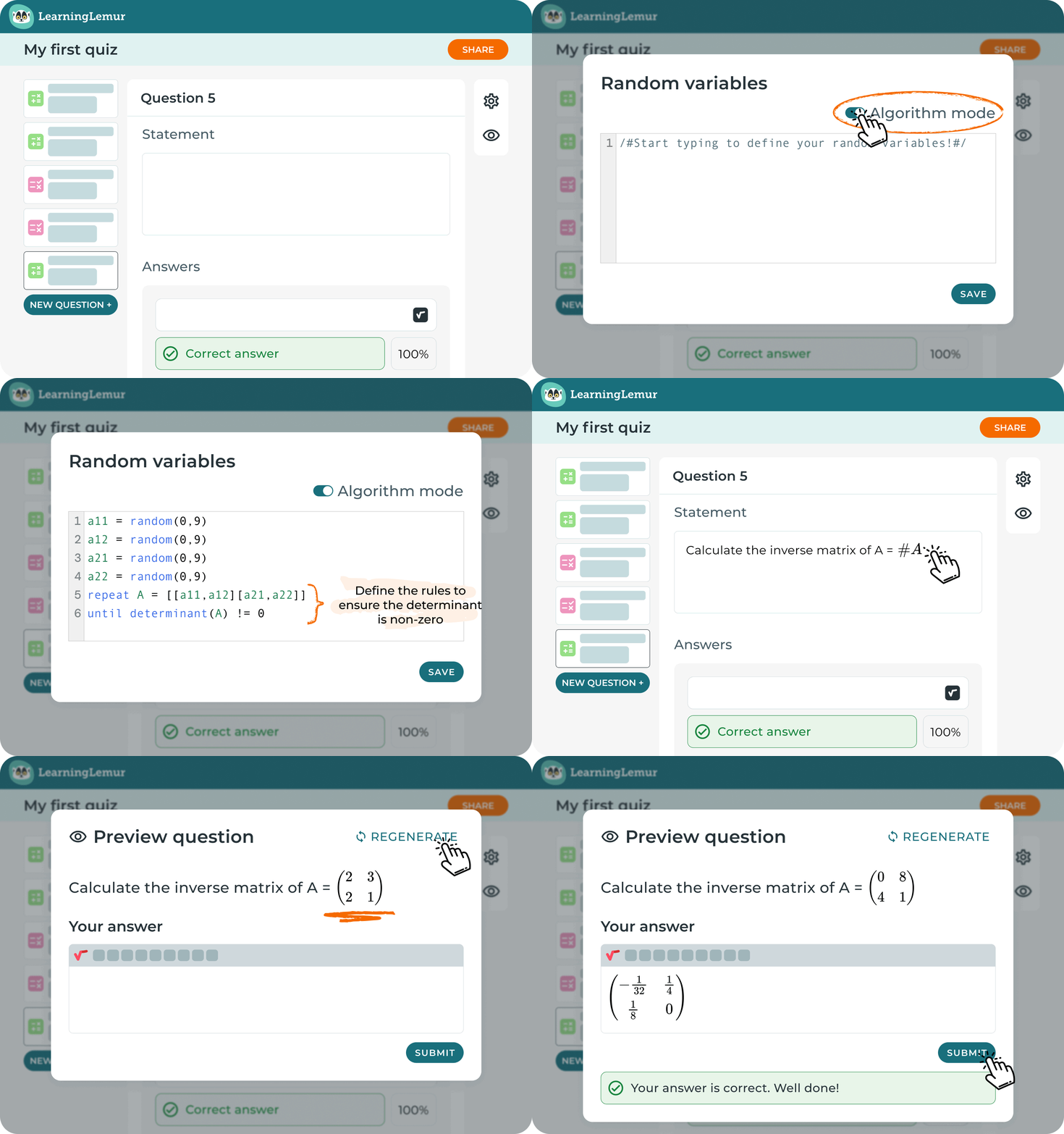
Algorithm Mode allows teachers to define the logic and constraints behind value generation. Instead of purely random inputs, educators specify the conditions that ensure every generated exercise remains mathematically valid and aligned with the learning objective.
For example, teachers can randomize coefficients, creating multiple versions of the first problem with the code:
# Generate random coefficients for a quadratic function
# a() cannot be 0 to ensure the function is quadratic
a() = random([1..5])
b() = random([-5..5]/[0])
c() = random([-5..5])

# Define the quadratic function
f = a()*x^2 + b()*x + c()

# Compute the x-coordinate of the extremum (vertex formula)
x0() = -b()/(2*a())

# Compute the y-coordinate of the extremum
y0() = a()*x0()^2 + b()*x0() + c()

# Return the extremum point (vertex)
extremum = (x0(),y0())
For eigenvalues, LearningLemur has a specific function that can calculate the eigenvalues of the matrix, to ensure the randomized matrix has a correct solution:
# Generate random integers between -5 and 5, excluding 0, for each matrix entry
a() := random([-5..5]/[0])
b() := random([-5..5]/[0])
c() := random([-5..5]/[0])
d() := random([-5..5]/[0])

# Repeat the process until the matrix has real eigenvalues
repeat
    A = [[a(), b()],
         [c(), d()]]

until (a()+d())^2 - 4*(a()*d() - b()*c()) >= 0

# Compute the eigenvalues of matrix A
e = eigenvalues(A)
This controlled variability allows instructors to:
- Generate multiple versions of the same conceptual task
- Ensure all variations remain mathematically valid
- Maintain the intended difficulty level
- Provide scalable practice across different types of math problems
In practice, this means that exercises like the quadratic extrema problem or the eigenvalue calculation shown earlier can be automatically varied while preserving their pedagogical structure. Students, therefore, encounter new instances of familiar math problems, reinforcing their skills through repeated yet meaningful practice.
Elevating math problems through immediate feedback and smart assessment
LearningLemur supports a shift in how math problems are approached in digital environments. Instead of focusing on step-by-step guidance, the platform emphasizes final answer validation and immediate feedback.
This approach encourages students to complete the full reasoning process on their own before checking whether their solution is correct, reinforcing both independence and mathematical rigor.
For students, instant correctness validation encourages careful reasoning and independent work when solving math problems. Instead of waiting for delayed corrections, learners immediately understand whether their solution is mathematically valid.
For educators, the platform enables scalable assessment without sacrificing rigor. Assignments can be generated, distributed, and evaluated efficiently while maintaining full control over the mathematical structure of each exercise.
This flexibility makes LearningLemur suitable for many different STEM contexts, from introductory algebra courses to more advanced topics in calculus and linear algebra.
Strengthening confidence through continuous practice
Mastery in STEM does not come from isolated exercises, but from consistent engagement with meaningful math problems. When students independently complete a task and immediately verify whether their solution is correct, they develop stronger analytical discipline and greater confidence in their reasoning.
LearningLemur supports this process by combining automatic grading, controlled randomization, and scalable assignment creation. Students focus entirely on solving math problems, while educators benefit from efficient digital assessment and precise evaluation.
In modern classrooms, speed, accuracy, and repetition are essential. By delivering immediate validation across levels -from secondary education to university algebra- LearningLemur helps transform math problems into structured opportunities for growth.
If you are looking to modernize your assessment workflow and reinforce rigorous solving of math problems, explore LearningLemur and experience how intelligent digital evaluation can elevate your STEM teaching.
Share


-
Start with LearningLemur now!
High-quality math practice. Zero grading bottlenecks.