

In this article
Some of the best online platforms for practicing math quizzes include Nubric, Khan Academy, IXL, Brilliant, and Wayground. The right choice depends on what you need: independent practice, curriculum-based exercises, interactive problem solving, classroom activities, or customizable math quizzes.
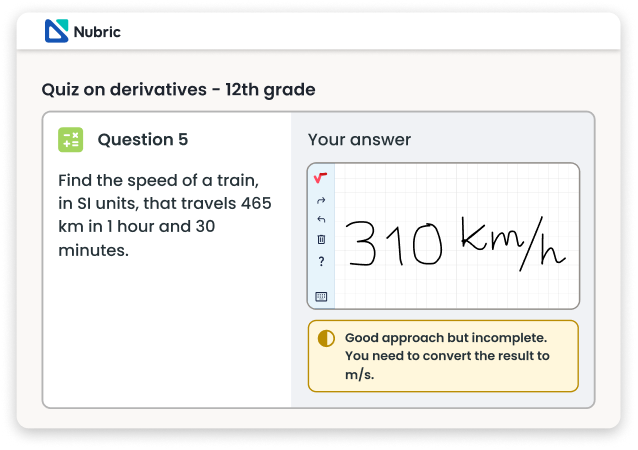
For teachers, there is another important consideration: how well the platform actually understands mathematics. Math assessment often involves equations, equivalent expressions, units, variables, and open-ended answers that conventional quiz tools may struggle to evaluate.
Here is a quick comparison:
| Platform | Best suited to |
| Nubric | Customizable math quizzes and mathematical assessments |
| Khan Academy | Free, self-paced math learning |
| IXL | K–12 skills practice |
| Brilliant | Interactive mathematical problem solving |
| Wayground | Interactive classroom quizzes |
Rather than looking for a single platform that is “best” for everyone, students and educators should choose based on how they want to practice mathematics.
What should you look for in an online math quiz platform?
A good math practice platform should do more than tell students whether an answer is right or wrong.
When comparing platforms, consider:
- Math-specific assessment: Can it understand equations, expressions, fractions, units, and other mathematical answers?
- Useful feedback: Does it help students understand their mistakes?
- Question variety: Can students practice different versions of the same mathematical concept?
- Customization: Can teachers create exercises that match what they are teaching?
- Progress tracking: Can educators identify concepts students are struggling with?
- Integrations: Does it work with the learning environment already used by the institution?
These criteria become particularly important when moving beyond multiple-choice questions.
Why are math quizzes different from standard online quizzes?
Mathematics cannot always be assessed through exact-answer matching.
Consider these two answers:
2(x + 1)
2x + 2
They are written differently, but they are mathematically equivalent.
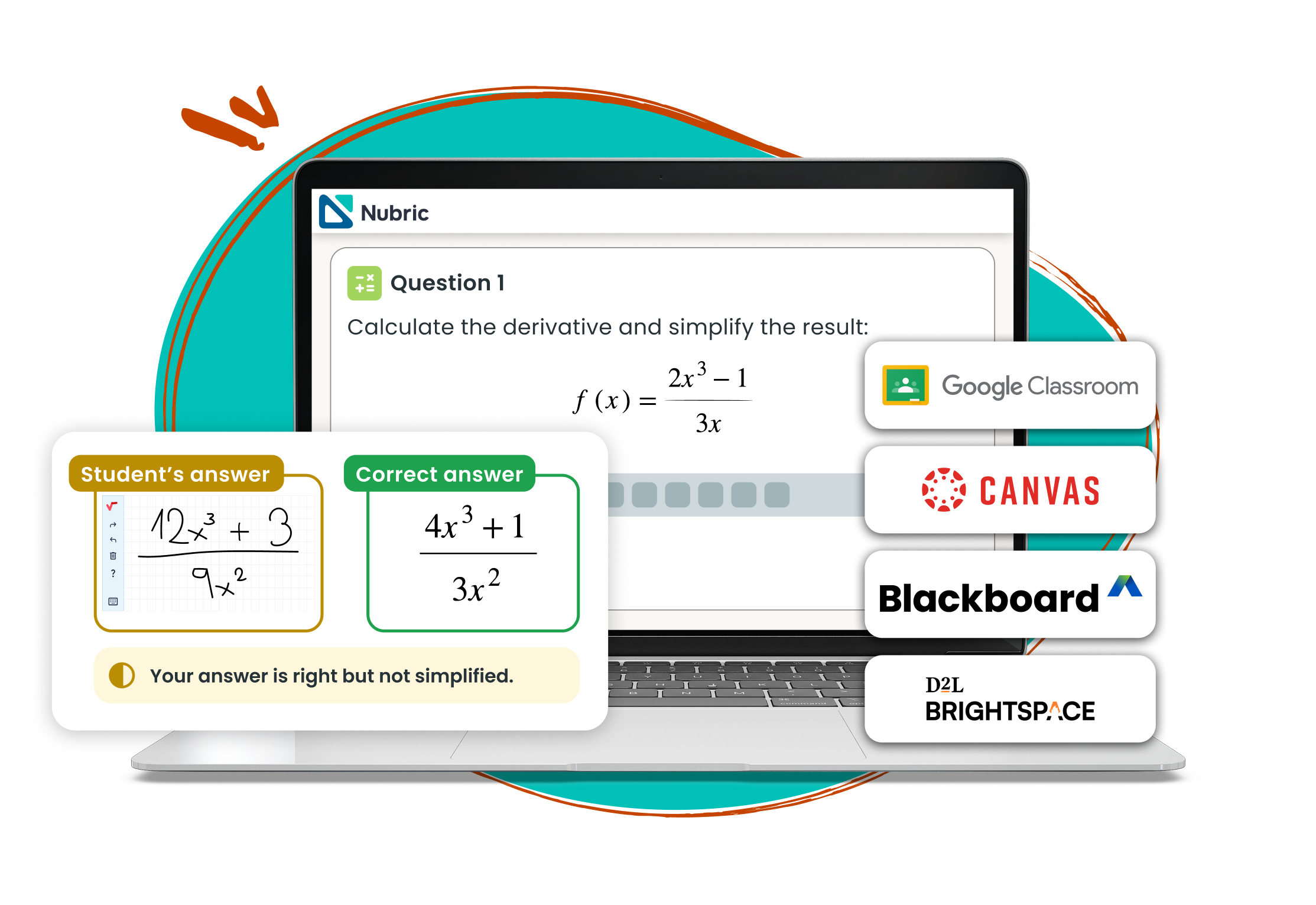
A conventional quiz tool may compare the student’s typed response with a predetermined answer. A math-specific assessment system can instead evaluate the mathematical meaning of the response.
This matters in subjects such as algebra, calculus, statistics, and physics, where students may reach the same valid answer in different forms.
At other times, the form of the answer does matter. A teacher might require a fraction instead of a decimal, specify particular units, or ask students to leave an expression in factored form.
Effective digital math assessment, therefore, needs to understand more than whether two strings of text look identical.
How can teachers create better online math practice?
Effective online math practice combines repeated problem solving with variation and meaningful feedback.
One way to achieve this is through randomized questions.
Imagine a teacher wants students to practice solving:
3x + 5 = 20
Instead of creating 10 separate questions manually, a platform can use variables to adjust coefficients and values while preserving the underlying mathematical concept.
Students can then encounter different versions of the problem rather than memorizing the answer to one fixed exercise.
This approach can make a single well-designed question reusable across practice sessions, homework, or different students.
Feedback is equally important. Instead of simply displaying incorrect, an online exercise can provide targeted guidance based on the student’s response, helping them identify what they need to reconsider.
Creating math quizzes with Nubric
Nubric is an online STEM assessment and math practice platform designed to help educators create, deliver, and automatically assess interactive math quizzes.
Its assessment engine is built around mathematics, allowing it to recognize mathematically equivalent answers and evaluate open mathematical responses.
For example, when appropriate, Nubric can recognize that 2(x + 1) and 2x + 2 represent equivalent expressions rather than marking one incorrect because it differs from a predefined string.
Educators can also create questions with random values, turning one exercise into multiple variations for repeated practice.
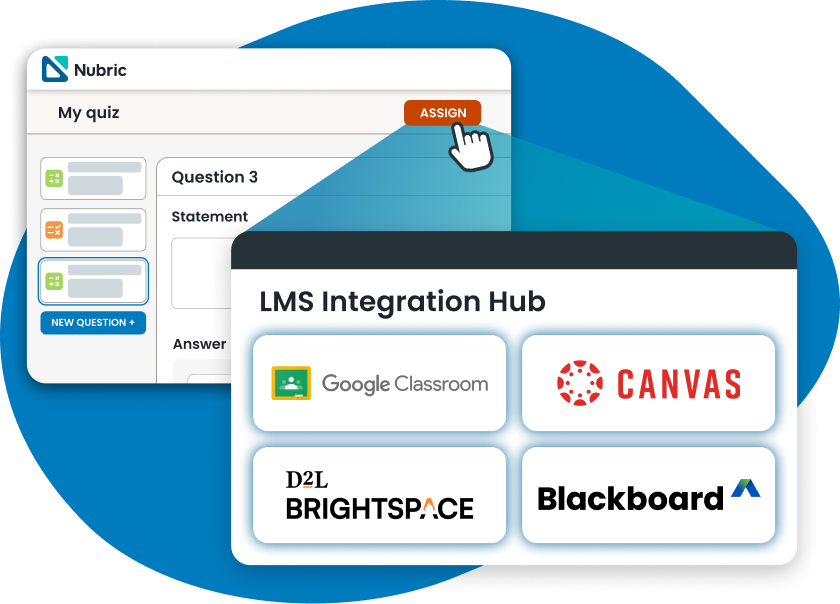
Nubric combines these capabilities with personalized feedback, AI-assisted question creation, reusable content, and integrations with learning environments such as Google Classroom, Canvas, Blackboard, and D2L Brightspace.
This makes it particularly suited to educators who want to create their own math practice rather than rely exclusively on a predefined library of exercises.
Which math practice platform should you choose?
The best math practice platform depends on your learning objective.
Students looking for independent learning can use platforms with established libraries of lessons and exercises, while teachers may need greater control over the questions students receive and how their answers are assessed.
The key distinction is whether you primarily need ready-made math practice or want to create and assess your own mathematical activities.
For educators, it is worth asking:
- What type of mathematics will students enter? Multiple-choice questions require different capabilities from algebraic expressions or equations.
- Do students need repeated practice? If so, look for ways to vary questions without recreating them manually.
- What feedback should students receive? Decide whether a score is enough or whether students need guidance after mistakes.
- Do teachers need to create their own content? Customization becomes important when exercises need to follow a particular curriculum or lesson.
- Does the platform understand mathematical equivalence? This is particularly relevant for open-ended mathematical questions.
The goal is not simply to move a worksheet online. The right platform should help students practice the mathematical concept itself.
Making online math practice more meaningful
Online math quizzes can give students more opportunities to practice, receive feedback, and learn from mistakes.
But mathematics creates assessment challenges that general-purpose quiz tools were not necessarily designed to solve. Equivalent expressions, open answers, variables, units, and different valid representations all make mathematical assessment more complex.
Nubric by Wiris is designed specifically around those challenges, helping educators create interactive STEM activities with mathematical assessment, question variation, and personalized feedback.
Share


-
Try Nubric now!
High-quality maths exercises. With autocorrect.